Environment

Climate Action & Just Transition

Integrate and adopt climate considerations for business resiliency and support the global energy shift towards an equitable and inclusive low-carbon economy through technology-driven optimisation and low-carbon solutions.

At Yinson, we integrate climate considerations into our governance, strategy and risk management to address climate risks and opportunities over the short, medium and long term.

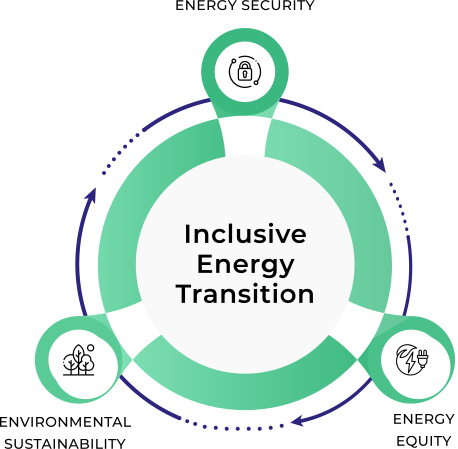
Our transition approach balances environmental sustainability, energy security and energy equity, supporting a gradual shift to a lower carbon economy by strengthening essential energy infrastructure while investing in renewables and green technologies.

Inclusive energy transition

A balanced approach to the energy trilemma to support the global energy shift towards an equitable and inclusive low-carbon economy through renewable and innovative low-carbon solutions.

We believe in a future where energy is clean, accessible, affordable and reliable for everyone. We strive to provide energy security and affordability to as many people as possible today, bringing them along through the transition.

Our businesses contribute to advancing an inclusive energy transition as depicted in the graphic below.

Environmental Stewardship

Promote responsible environmental management by optimising resource use, emissions, and implementing circular practices or effective control of waste, water, effluent and air pollution.

Yinson embeds robust waste and pollutant management practices across its offshore operations to ensure compliance, operational efficiency and environmental protection.

This is supported by our Integrated HSSEQ Management System, aligned with ISO 9001, ISO 14001 and ISO 45001, which governs environmental impact management, regulatory compliance, incident investigation and continual improvement.

Biodiversity Management

Strategies to optimise nature-related impacts and dependencies from operations to enhance ecosystem resilience through partnership and conservation efforts.

Yinson is committed to supporting biodiversity conservation across all countries in which we operate. We manage biodiversity as a material matter by integrating nature-related considerations into our decision-making, risk management and business planning processes.

Guided by our Biodiversity Policy, and informed by recognised frameworks such as the Kunming-Montreal Global Biodiversity Framework and the Taskforce on Nature-related Financial Disclosures (TNFD), we adopt a structured approach to identifying, assessing and managing our nature-related impacts, dependencies, risks and opportunities.

We also promote employee-driven biodiversity initiatives while embedding conservation practices across our operations to support positive outcomes for nature.

Resource efficiency

Responsible use of input material in product development, construction and operations.

Infrastructure assets, such as our FPSOs and solar farms, are resource-intensive due to their sheer scale and complexity. Prioritising efficient and responsible resource utilisation over the projects and operations phases of our assets is paramount so that we can ensure that our assets can contribute to economic growth without negatively affecting natural resources.

On our FPSOs, design solutions that contribute to resource efficiency include combined cycle technology, electrification of our FPSOs, variable frequency drives, seawater turbine generators and digitalisation technologies. In our renewables business, we consider environmental footprint when selecting equipment and product, practice strict quality controls to ensure materials are used efficiently and incorporate end-of-life recycling as part of our procurement evaluation.

See next

Social

Yinson’s climate strategy

The global structural shifts towards a low-carbon economy and the urgent push from governments for self-sufficiency and energy security have continued to drive sustainable infrastructure investments. Yinson continues to be transition-focused as a Group. As part of our overarching strategy, we consciously adjust various levers to balance the speed of our transition with global market factors such as inflation, supply chain constraints, and capital cost for growth.

Yinson Climate Goals

Yinson has set ambitious targets to achieve carbon neutrality by 2030 (encompassing Scopes 1 and 2 emissions) and net zero emissions by 2050 (encompassing Scopes 1, 2 and 3 emissions).

Carbon neutral by 2030

Reduce Group-wide Scope 1 and 2 GHG emissions to the lowest possible levels while compensating for any residual emissions via carbon offsets to achieve carbon neutrality by 2030.

Net zero by 2050

Reduce Group-wide Scope 1, 2, and 3 GHG emissions to the lowest possible levels while compensating for and removing any residual emissions to achieve net zero by 2050.

Three-pronged Climate Strategy

As our key businesses contribute to the building of sustainable energy infrastructure that empowers communities, drives economic growth, and protects the environment for current and future generations, we continue to operationalise our climate strategy through a three-pronged approach.

Carbon Reduction

Reduce emissions across Scopes 1, 2, and 3 by optimising internal processes and operations, while adopting innovative emissions-reducing technologies and utilising renewable energy where possible.

Carbon Removal

Explore various nature-based (such as afforestation and reforestation) and technology-based atmospheric carbon removal solutions (such as direct air capture) for residual emissions across Yinson’s footprint.

Carbon Compensation

Utilise carbon compensation mechanisms, including high integrity and high-quality carbon credits, to offset residual Scope 1 and 2 emissions after reduction efforts.

Yinson’s Climate Report

Yinson’s Climate Report outlines Yinson’s climate strategy and approach to net zero, the progress of our climate action, and the methods adopted for the management of climate risks and opportunities.

The Climate Report 2024 streamlines our disclosures into a single document. The Report continues to adopt and align with applicable climate-related disclosure frameworks, including TCFD, ISSB S2 and TPT, ensuring our climate transition plans are robust, credible, and aligned with industry best practices.